
Who This Guide Is For
This guide is written for SEO professionals, content marketers, andIf you are still measuring SEO success purely by tracking traditional blue links, you are optimizing for a search engine that no longer exists.
By 2026, the SERP landscape has been completely rewired. Google’s AI Overviews now intercept the majority of informational and commercial queries, delivering AI-generated snapshots directly at the top of the page. If your brand or content is not cited within that snapshot, you are effectively invisible to a massive portion of your potential audience. To navigate this new environment, utilizing the Best AI Overviews Analysis Tools is essential for success.
Whether you manage a dropshipping store, a health news network, or a tool directory like ToolSearchWeb.com, surviving this shift demands a fundamentally new approach. You need a dedicated AI Overviews analysis tool to decode how Large Language Models (LLMs) evaluate, rank, and cite your content.
This guide covers the top tools SEO professionals are using right now to dominate AI-driven search results — with honest pros, cons, and pricing for each of the Best AI Overviews Analysis Tools.
website owners who already understand fundamental SEO but want to adapt their strategy for Google’s AI-first results. Whether you manage a single blog or a network of hundreds of sites, the tools below will help you stay visible in 2026 and beyond.
Staying competitive also means being aware of the Best AI Overviews Analysis Tools that can provide deeper insights and analytics.
| Quick Tip: You do not need to use all four tools. Start with the one that matches your current budget and team size, then expand as your strategy matures. |
Why You Need a Dedicated AI Overviews Analysis Tool
Standard keyword trackers are built to measure a world of ten blue links. They cannot reverse-engineer generative AI outputs. The core metrics of search visibility have fundamentally evolved. Modern SEOs now need software that can answer an entirely new set of questions:
- Citation Tracking: Is the AI pulling facts and quotes from your pages or your competitors’ pages?
- Visibility Volatility: How often is an AI Overview snapshot triggering for your target keywords?
- Sentiment Analysis: When the AI mentions your brand or product, is the framing positive, neutral, or negative?
- Click Impact: How much organic CTR are you losing because an AI snapshot is answering the query before a user reaches your link?
A dedicated AI analysis tool is no longer optional. It is a mandatory part of any serious SEO tech stack in 2026.
Top Picks: Best AI Overviews Analysis Tools in 2026
After extensive hands-on testing and industry benchmarking, these four platforms stand out for their ability to break down and optimize for AI search features.
1. Semrush — Best All-in-One Suite

Semrush has aggressively evolved its platform to meet the AI era. Its built-in AI Overview tracking features are ideal for SEO teams that want deep data integrated into the workflow they already know. Semrush connects AI visibility data directly with your existing keyword and backlink research, making it the most practical choice for most agencies and in-house teams.
Standout Features:
- Competitor Citation Mapping: Instantly reveals which domains are winning AI answers for your target keywords.
- AIO Optimization Score: Evaluates your existing pages and scores them based on how likely Google is to use them as an AI citation source.
- Traffic Impact Estimation: Connects with Google Search Console to estimate real CTR loss or gain caused by AI Overviews.
Pricing: Plans start from approximately $139/month. Free trial available.
Best For: Agencies, in-house SEO teams, and anyone who wants everything in a single platform.
2. Ahrefs — Best for Deep Content Intelligence
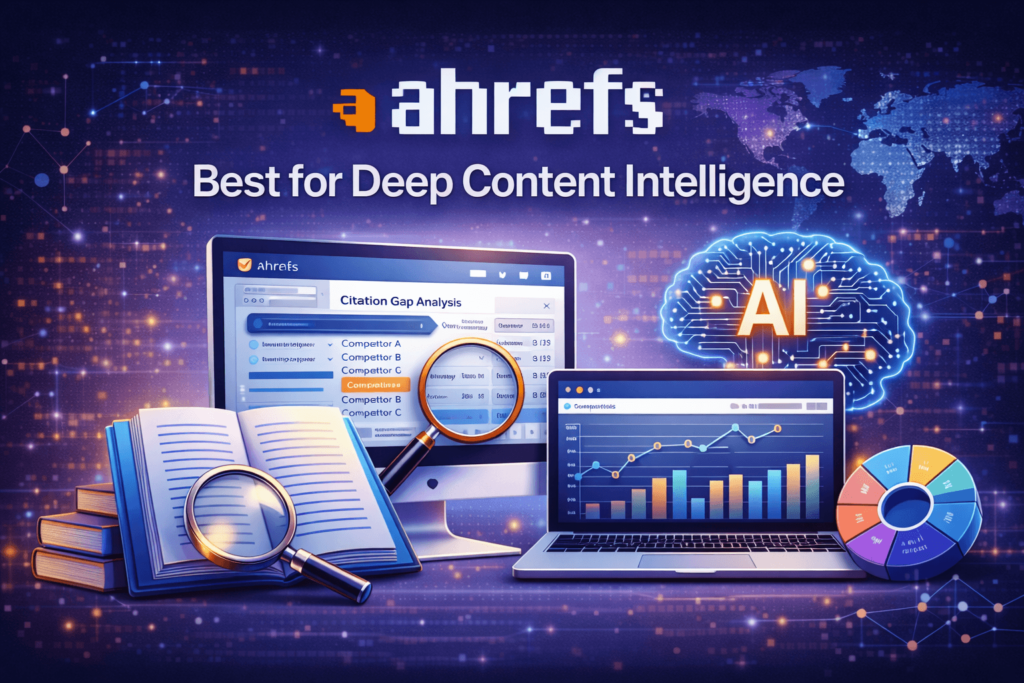
Ahrefs has built its AI Overview tracking around a powerful core insight: an AI citation is the new backlink. Their content intelligence features are purpose-built for competitive analysis, helping you understand not just if you were cited, but exactly what made a competitor’s content citation-worthy.
Standout Features:
- Exact Passage Highlighting: Shows you the specific paragraph or sentence the AI extracted from a cited page — not just the URL.
- AI Authority Score: Measures the overall citation authority of any domain by tracking how often it appears in AI Overviews across a large query dataset.
- Content Gap for AI: Surfaces high-volume keywords where competitors are featured in AI snapshots but your site is completely absent.
Pricing: Plans start from approximately $129/month. No traditional free trial, but a limited starter plan is available.
Best For: Content-heavy sites, SEO consultants focused on competitive strategy, and teams that rely on data-driven content gap analysis.
3. BrightEdge — Best for Enterprise Sites
For large-scale websites managing thousands of pages, manual AI analysis is simply not feasible. BrightEdge brings heavy automation and enterprise-grade data infrastructure to AI SEO, making it the go-to choice for large brands, publishers, and Fortune 500 marketing teams.
Standout Features:
- Real-Time SERP Rendering: Captures live, accurate snapshots of volatile AI Overviews instead of relying on cached data.
- Automated Optimization Suggestions: Flags pages losing traffic to AI features and automatically recommends specific text modifications to improve citation likelihood.
- AI Schema Builder: Guides your development team on implementing the exact structured data markup that 2026 AI crawlers prefer.
Pricing: Custom enterprise pricing. Contact BrightEdge directly for a quote.
Best For: Enterprise websites, large media publishers, and retail brands managing thousands of pages.
4. SE Ranking — Best Budget-Friendly Option
Not every SEO team has an enterprise budget. SE Ranking has emerged as one of the most capable and affordable tools for tracking AI Overviews, making it the top recommendation for freelancers, small agencies, and independent website owners who need real data without a premium price tag.
Standout Features:
- AI Overview Monitor: Tracks whether AI snapshots are appearing for your keywords and whether your site is featured as a source.
- SERP Volatility Tracker: Measures how frequently the AI Overview for a given keyword changes, helping you identify unstable opportunities.
- On-Page AI Optimization Checker: Reviews your content against the structural signals that AI systems favor for citation.
Pricing: Plans start from approximately $65/month. Free trial available.
Best For: Freelancers, small agencies, bloggers, and businesses that need solid AI tracking on a controlled budget.
Quick Comparison: All Four Tools at a Glance
Use this table to quickly match a tool to your specific needs and budget.
| Tool | Best For | Pricing (Est.) | AI Citation Tracking | AIO Monitor | Free Trial |
|---|---|---|---|---|---|
| Semrush | All-in-one teams | From $139/mo | Yes | Yes | Yes |
| Ahrefs | Content intelligence | From $129/mo | Yes | Yes | No |
| BrightEdge | Enterprise sites | Custom pricing | Yes | Yes | No |
| SE Ranking | Budget-friendly | From $65/mo | Yes | Yes | Yes |
Choosing the Right Tool for Your Strategy
Your ideal tool depends entirely on your operational context, team size, and budget. Here is a simple decision framework:
- Go with Semrush if you need a balanced, all-around platform that integrates directly into your existing keyword research and site audit workflow.
- Choose Ahrefs if your strategy relies heavily on content gap analysis, reverse-engineering competitor citations, and passage-level content intelligence.
- Opt for BrightEdge if you manage a massive enterprise site and need automation, real-time rendering, and structured data guidance at scale.
- Select SE Ranking if you are working with a tight budget but still need legitimate, reliable AI Overview tracking and monitoring.
| Pro Tip: Many professional SEOs use two tools in combination — typically Semrush or Ahrefs for strategy and content planning, paired with SE Ranking for ongoing daily monitoring. This gives you the best of both worlds without paying enterprise prices. |
How to Optimize Your Content for AI Overviews
Choosing the right tool is only half the battle. Here are the core optimization principles that will directly improve your chances of being cited in an AI snapshot:
- Write definitive, direct answers: AI systems favor content that clearly and confidently answers the core question without burying the lead.
- Use structured data (Schema markup): Implement FAQ, HowTo, and Article schema to give AI crawlers additional context about your page content.
- Build topical authority: Cover your subject area deeply and comprehensively. AI models trust domains that demonstrate consistent expertise across related topics.
- Earn citations from trusted sites: AI models look for consensus across authoritative sources. Strong digital PR and being referenced by reputable publishers significantly increases your citation likelihood.
- Prioritize clean, scannable formatting: Use clear H2 and H3 headings, short paragraphs, and bullet lists so AI systems can easily extract structured information from your pages.
Frequently Asked Questions (FAQs)
What is an AI Overview analysis tool?
An AI Overview analysis tool is specialized software designed to track, analyze, and decode the AI-generated answers that appear at the top of Google search results. These tools help webmasters understand whether their content is being cited as a source, how frequently AI snapshots appear for their target keywords, and what specific content changes could improve their citation likelihood.
How do I optimize my content for AI Overviews?
Effective AI Overview optimization involves writing clear, authoritative answers to complex questions, implementing robust Schema markup, and building strong topical authority within your niche. Because AI models look for consensus across trusted sources, a strong digital PR presence and being referenced by other credible websites are also key ranking signals.
Are traditional rank trackers obsolete in 2026?
They are not completely obsolete, but they now only tell half the story. A traditional tracker might show you ranking in position one organically, but an AI Overview analysis tool will reveal that an AI snapshot has pushed your result entirely below the visible screen on mobile — which can dramatically reduce your expected organic traffic despite the high ranking.
Is AI Overviews tracking available on free SEO tools?
Dedicated AI Overview tracking is not available on most free SEO tools at this time. Google Search Console provides limited visibility into impressions from AI-cited pages, but for serious, actionable tracking, a paid platform is currently necessary. SE Ranking is the most affordable entry point among the tools reviewed in this guide.
How frequently do AI Overviews change?
AI Overviews are highly volatile and can update multiple times per day depending on query intent signals, newly published content, and algorithm adjustments. This volatility is precisely why real-time tracking tools deliver far more actionable intelligence than weekly snapshot reports or manual SERP checks.
Final Thoughts
The shift to AI-powered search is not a future event to prepare for. It is the present reality you are already operating inside.
The SEO professionals who will build durable visibility in 2026 and beyond are those who stop treating AI Overviews as an obstacle and start treating them as a primary optimization target. The tools reviewed in this guide give you the data infrastructure to do exactly that.
Start with the platform that matches your current team size and budget. Integrate AI citation tracking into your standard monthly reporting. Then treat every AI Overview on your target keywords as a content brief waiting to be won.
The brands appearing in those AI snapshots are not there by accident. They are there because someone analyzed the data, improved the content, and earned the citation. That can be your site.
Disclosure: Pricing information is approximate and subject to change. Always verify current pricing on the tool’s official website before purchasing. Some links on this page may be affiliate links, which help support the free content on ToolSearchWeb.com at no additional cost to you.